

You’ve been here before. You started January with a new resolution — keto, 10,000 steps a day, giving up rice completely. For a few weeks, it worked. Then it stopped. Or worse, the weight came back, sometimes more than before.
Your mother-in-law has opinions. Your doctor said, “Just eat less.” Your colleague lost 8 kilos doing intermittent fasting and now swears by it. You tried that too. Nothing.
You’re not lazy. You’re not weak-willed. You’re not imagining it.
If you’ve genuinely tried dieting, exercise, fasting, and every lifestyle change — and the scale still won’t move, or keeps moving the wrong way — there’s often a real, medical reason behind it. Something measurable. Something treatable.
This isn’t another diet plan or a lecture on willpower. It’s an honest look at why “why am I not losing weight despite dieting” is one of the most searched phrases in India right now — and what you can actually do about it.
It also explains why so many people keep gaining weight even after trying hard, and why diets fail when the real cause is hormonal, metabolic, stress-related, sleep-related, gut-related, or medicine-related.
1. Your Hormones Might Be Working Against You
Your body runs on hormones — chemical messengers that regulate hunger, fat storage, metabolism, and energy levels. When even one goes slightly off, you can gain weight no matter how hard you try. In India, hormonal imbalances are far more common than most people realise, especially in women between 25 and 45.
Hormonal imbalance is one of the most important medical reasons for weight gain, especially when diet and exercise are not giving results.
Is it your thyroid?
Your thyroid is a small gland in your neck that controls how fast or slow your metabolism runs. When it’s underactive, which is called hypothyroidism, everything slows down — digestion, energy, mood, even body temperature. The most common version in India is subclinical hypothyroidism, where the symptoms are vague enough to dismiss: tiredness, weight gain, dry skin, hair fall, constipation, feeling cold.
Many women live with this for years without a diagnosis because it gets written off as stress or “just getting older.” A simple TSH blood test can tell you if this is the case.
Insulin resistance
Think of insulin as a key and your cells as locked doors. Insulin lets sugar into your cells for energy. In insulin resistance, the key stops fitting the lock — so your pancreas pumps out more and more insulin. And extra insulin does one thing very well: it tells your body to store fat, especially around your belly.
A diet heavy in white rice, maida, sugar, and processed food makes this worse. You can have insulin resistance without having diabetes, and it can cause real weight gain even if you’re eating “relatively well.”
Stress and belly fat
Cortisol is your stress hormone. It’s meant to help you in short bursts — running from danger. It’s not meant to be switched on for hours every day because of traffic, deadlines, or lying awake worrying at 1 am.
When stress doesn’t let up, cortisol stays high — and that does two things: it ramps up cravings, especially for sweet and salty food, and it tells your body to store fat around your stomach. This is one of the most common reasons for stubborn belly fat in urban Indians. It’s not a weakness. It’s biology.
For many people searching for stress weight gain belly, the real concern is the connection between chronic stress and belly fat. Stress and belly fat often go together because your body is staying in survival mode for too long.
PCOD
PCOD affects many women in India, and weight gain is one of its most frustrating symptoms. The hormonal imbalance behind PCOD makes it genuinely harder for the body to burn fat efficiently.
Worse, PCOD causes weight gain, and weight gain makes PCOD worse — a loop that diet and exercise alone usually can’t break. PCOD and weight gain need medical management, not just a stricter routine.

2. Your Gut Health Could Be the Problem
Your gut is home to trillions of bacteria that do far more than digest food — they affect how many calories you actually absorb, how your hunger hormones behave, and how much inflammation is in your body.
Two people can eat the same meal and absorb very different amounts of energy from it, partly because of differences in gut bacteria. Frequent antibiotics, a diet low in fibre, lots of packaged food, chronic stress, and irregular meal times can all throw your gut off balance — which can trigger low-grade inflammation and mess with leptin, your “I’m full” hormone.
If you regularly deal with bloating, constipation, acidity, or irregular digestion, your gut may be playing a bigger role in your weight than you think.
This is why gut health and weight gain should be looked at together. Sometimes the problem is not just how much you eat, but how your gut processes food, hunger, fullness, and inflammation.

3. Not Sleeping Enough? That’s a Big One
Sleep isn’t just rest — it’s when your body resets the hormones that control hunger. Two matter most: ghrelin, which makes you hungry, and leptin, which tells you to stop eating.
Sleep less than 7 hours, and ghrelin goes up while leptin goes down. The next day, you’re hungrier, you crave heavier food, and you feel less satisfied even after eating. That’s not a willpower issue — it’s your hormones doing exactly what they’re wired to do.
This is a real problem in Indian households where dinner often happens at 9, 10, or even 11pm. A heavy meal right before bed spikes blood sugar at the exact time your body is winding down and least equipped to handle it — which disrupts sleep, which throws off your hunger hormones the next day.
Poor sleep and weight gain are closely connected. If you’re regularly getting under 6 hours of sleep, no diet will give you the results you’re hoping for.

4. Check Your Medicines
This one gets talked about the least — and it matters more than people realise. Several common medicines can cause weight gain as a side effect.
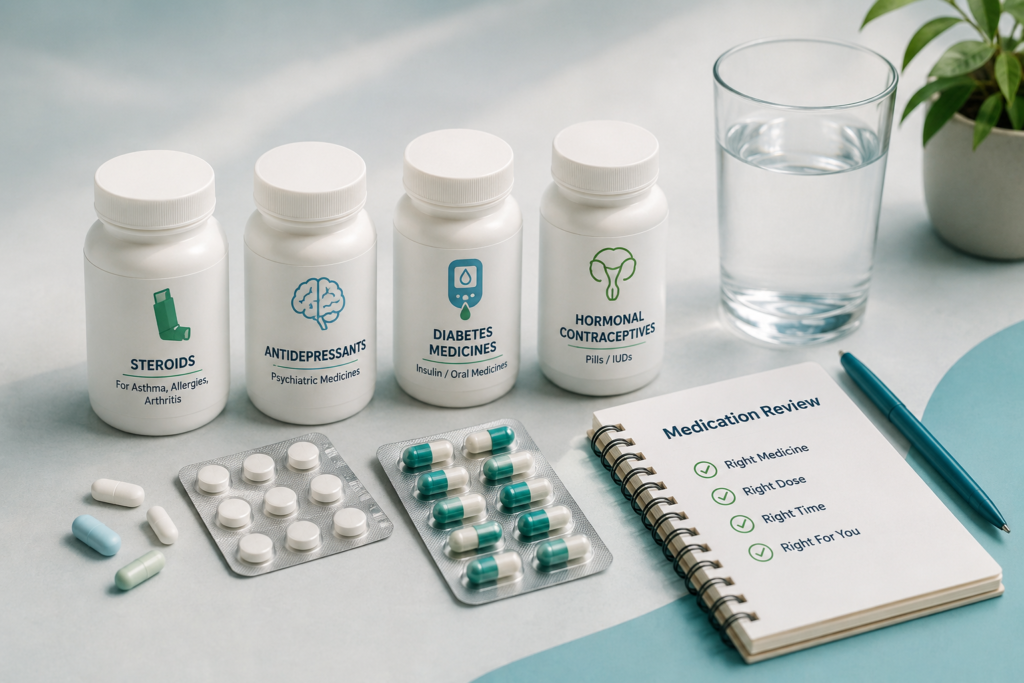
In fact, medicines that cause weight gain are one of the most overlooked medical reasons for weight gain, especially when someone is taking long-term treatment for asthma, allergies, diabetes, mood disorders, or hormonal concerns.
Steroids
Steroids, often used for asthma, allergies, arthritis, and skin issues, can cause water retention and fat redistribution. Even short courses can change your weight temporarily. Long-term low-dose use is a common, quiet cause of steady weight gain.
The steroids weight gain connection is important because many people never link their weight changes to repeated or long-term steroid use.
Antidepressants and psychiatric medicines
Many antidepressants and psychiatric medicines can increase appetite or change metabolism and gut function. This doesn’t mean you should stop them — your mental health matters more — but your doctor should know this is happening.
Diabetes medicines
Insulin and certain oral diabetes medicines lower blood sugar partly by promoting fat storage. A frustrating irony: the medicine managing one condition can make another harder to control.
Hormonal contraceptives
Some pills and IUDs cause weight gain in certain women, though this varies a lot from person to person.
Never stop any of these on your own — the risks of untreated diabetes, depression, or asthma are far more serious than weight gain. Instead, talk to your doctor about a medication review.
5. Desk Jobs + Packaged Food = Trouble
Desk job weight gain is now extremely common because many people sit for 8 to 10 hours a day, move less than they realise, and snack more often because food is always nearby.
Why can’t you stop at one biscuit
Think about the last time you grabbed a handful of biscuits to get through the 4 pm slump — and finished half the packet without noticing. That’s not a lack of willpower. That’s food engineering.
Ultra-processed foods such as biscuits, namkeen, instant noodles, chips, flavoured yoghurt, and packaged juices are built to override your body’s fullness signals. They’re calorie-dense, low in fibre and protein, and designed to make you want more.
This is especially true in Indian homes and offices, where packaged snacking has quietly replaced a handful of peanuts or a small bowl of poha. That “diet” biscuit? Often just as much sugar and refined flour as the regular one.
Working from home changed everything
Work-from-home weight gain became very common after the pandemic. Before COVID, most office workers walked to a bus stop, climbed stairs, walked to the canteen, and moved between meetings. Now, for many people, the daily commute is bed to desk and back.
Add the blurred line between work and kitchen, more stress, disrupted routines, and late-night screen time — and it’s easy to see why so many people gained weight after COVID, without necessarily eating more. Their whole daily biology changed.
6. Emotional Eating Is Real, Not a Character Flaw
Why stress makes you crave carbs
When you’re stressed, your brain’s serotonin, the “calm” chemical, drops. Carbs — especially sweet or starchy ones — trigger a quick serotonin release. So when you reach for mithai, bread, or rice while anxious or overwhelmed, that’s your brain looking for a chemical fix, not a lack of discipline.
This is another reason stress and belly fat are linked. Stress increases cravings, cravings increase calorie intake, and the body is already more likely to store fat around the abdomen.
The restrict-binge cycle
A lot of people fall into a pattern:
Restrict hard, skip meals, cut carbs, or fast → feel deprived → stress triggers eating → eat past the point of fullness → feel guilty → restrict again.
Each round makes it worse. Severe restriction lowers mood and raises cortisol, which fuels more cravings — and the guilt afterwards becomes its own source of stress. Over time, this wears down both your relationship with food and your metabolism.
Emotional eating is a recognised pattern with real psychological roots. It doesn’t go away with more willpower — it needs proper, compassionate support.

7. Old Crash Diets May Have Slowed Your Metabolism
This one’s hard to hear, but it’s not your fault. Every time you cut calories drastically — crash diets, the GM diet, juice fasts, skipping meals for long stretches — your body reads it as a famine. So it lowers your basal metabolic rate, also called BMR, which is the number of calories you burn just staying alive.
This is called metabolic adaptation. Your body becomes more “fuel-efficient” to survive on less. When you go back to eating normally, which everyone eventually does because extreme restriction never lasts, your slower metabolism means the weight comes back fast — often with a little extra, as your body tries to protect itself from the next “famine.”
This is the biology behind yo-yo dieting, where every round of dieting and regaining leaves you a bit heavier than before. If you’ve been on and off diets for years, your metabolism may genuinely be slower than it should be.
This is also why diets fail for many people. The problem is not always commitment. Sometimes the body has adapted to repeated restriction and needs a medically guided plan, not another crash diet.
This is measurable — and treatable. Just not with another crash diet.
Quick Self-Check: Which of These Sounds Like You?
| Symptoms you notice | Possible cause |
| Weight gain + hair fall + fatigue + feeling cold | Thyroid, hypothyroidism |
| Belly fat + sugar cravings + dark neck or underarms | Insulin resistance |
| Belly fat + poor sleep + feeling anxious or wired | High cortisol, stress, and belly fat |
| Irregular periods + weight gain + acne or hair growth | PCOD and weight gain |
| Bloating + acidity + constipation + gas | Gut imbalance, gut health, and weight gain |
| Less than 6 hours of sleep + hungrier the next day | Poor sleep and weight gain |
| Taking steroids, antidepressants, or diabetes medicines | Medication-related weight gain: medicines that cause weight gain |
| Working from home + more snacking + less movement | Work from home weight gain |
| Sitting for long hours + packaged snacks | Desk job weight gain |
| Eating when stressed, anxious, or bored | Emotional eating cycle |
| Multiple crash diets in the past | Slowed metabolism |
This table is for general awareness only and isn’t a substitute for medical advice.
What to Do Now
Here’s the thing to take away from all this: unexplained weight gain in India — especially in women — is very often a medical issue with a medical solution.
Thyroid imbalances can be corrected with medication. Insulin resistance can be reversed with the right mix of diet, activity, and sometimes medicine. PCOD can be managed. Gut health can be restored. Sleep can be fixed. Medication side effects can be discussed and adjusted. Emotional eating responds well to the right support. And a slowed metabolism can be rebuilt through a structured, medically guided plan — not another crash diet.
The right starting point isn’t a new diet. It’s a proper check-up — one that actually looks at your hormones, metabolism, gut health, sleep, stress, medicines, and full medical history to find out what’s really going on.

FAQs
Why am I gaining weight even though I’m eating less?
Eating less doesn’t fix things like an underactive thyroid, insulin resistance, or a metabolism that’s slowed down from past crash diets. If you’re genuinely eating in a deficit and still gaining, it’s worth getting your hormones and metabolic health checked rather than cutting calories further.
Can stress alone cause weight gain?
Yes. Chronic stress keeps cortisol elevated, which increases cravings and pushes your body to store fat around the belly. It’s a real, measurable effect — not just “stress eating” in your head.
What is the connection between stress and weight gain in the belly?
The phrase stress weight gain belly usually refers to the way chronic stress can increase cortisol and encourage fat storage around the stomach. This is why stress and belly fat are often connected.
How do I know if my weight gain is due to thyroid issues?
Common signs include fatigue, hair fall, feeling cold, dry skin, and constipation, along with weight gain. A simple TSH blood test can confirm it, so it’s worth asking your doctor for one if these sound familiar.
Is it possible to have insulin resistance without diabetes?
Yes, and it’s actually quite common. You can have insulin resistance for years before it progresses to prediabetes or diabetes, and it can cause weight gain — especially around the belly — well before your sugar levels are officially “high.”
Can medicines really be the reason I can’t lose weight?
Yes. Steroids, certain antidepressants, some diabetes medicines, and some hormonal contraceptives are known to cause weight gain. Never stop a prescribed medicine on your own — talk to your doctor about whether an alternative is possible.
Which medicines can cause weight gain?
Some medicines that cause weight gain include steroids, certain antidepressants, some diabetes medicines such as insulin, and some hormonal contraceptives. The weight gain effect of steroids is especially important if steroids are used repeatedly or for a long time.
Does poor sleep actually affect weight, or is that exaggerated?
It’s not exaggerated. Poor sleep and weight gain are closely linked. Sleeping less than 7 hours changes the hormones that control hunger and fullness, making you hungrier and more likely to overeat the next day. It’s one of the most underrated factors in weight gain.
Can gut health affect weight gain?
Yes. Gut health and weight gain can be connected because gut bacteria influence digestion, inflammation, hunger hormones, and how your body processes food.
Why do desk jobs cause weight gain?
Desk job weight gain usually happens because long sitting reduces daily movement, while office snacking, stress, and packaged food increase calorie intake without making you feel full.
Why did I gain weight after working from home?
Work-from-home weight gain became common because step counts dropped, kitchen access increased, stress rose, and sleep routines were disrupted. Many people did not eat dramatically more, but their daily movement and routine changed.
Will dieting again fix the damage from my past crash diets?
Usually not — another crash diet can make metabolic adaptation worse, not better. This is one reason why diets fail again and again. What actually helps is a structured, medically guided approach that rebuilds your metabolism gradually instead of restricting it further.
When should I see a doctor about unexplained weight gain?
If you recognise two or more patterns from the self-check table above, or if lifestyle changes genuinely haven’t worked despite real effort, it’s time for a proper medical evaluation rather than another diet plan.
Recognise Two or More of These in Yourself?
If two or more of these reasons sound like you, your weight concerns deserve more than another generic diet plan. They deserve a proper medical evaluation.
Book a consultation at Rogtham. Our team will help you find the real root cause of your weight gain — hormonal, metabolic, gut-related, medication-related, sleep-related, stress-related, or a mix — and build a plan that actually addresses what’s happening in your body.
You’ve tried willpower. It’s time to try science.
Book Your Consultation at Rogtham → https://rogtham.com/obesity-weight-loss-program/
This article is for informational purposes only and does not constitute medical advice. Please consult a qualified healthcare professional for personal medical guidance.