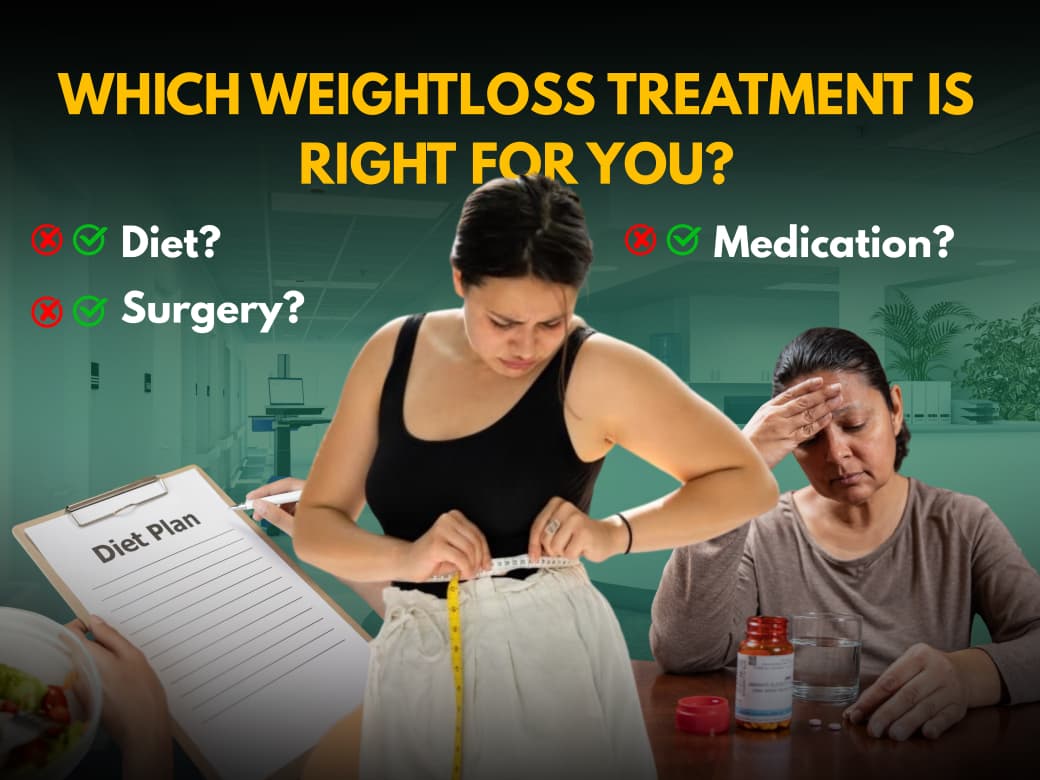

You’ve probably already tried intermittent fasting. Maybe the gym membership you bought in January is gathering dust by March. Or you’ve spent a week down a rabbit hole comparing Ozempic and Mounjaro reviews on Reddit, wondering if bariatric surgery is something you should even be considering.
If any of that sounds familiar, you’re not alone — and you’re not doing anything wrong.
Government health survey data show that nearly a quarter of Indian men and women are now overweight or obese, up sharply from just five years earlier. That’s not a personal failure story. That’s a country-wide shift, driven by changing food habits, desk jobs, and city life — and it’s exactly why treatment for weight loss has become such a crowded, confusing space, with everyone from Instagram coaches to hospital chains claiming they have the answer.
Here’s the one honest thing we can tell you upfront: nobody has a single answer that works for everyone. Not a diet. Not an injection. Not even surgery. What works depends entirely on your body, your numbers, and what’s actually driving your weight gain. So let’s walk through this properly — the real options, the real costs, the real catches — so you can make a decision with your eyes open, not one based on whichever ad you saw last.
First, Let’s Get the Diagnosis Right
Before anyone can tell you what treatment you need, they need to actually understand what’s going on in your body. And the bathroom scale barely scratches the surface.
BMI is the number everyone knows — weight relative to height. It’s a decent starting point, but it can’t distinguish between someone carrying muscle and someone carrying fat. Which is why doctors also look at waist measurement, which tells you how much fat is sitting around your organs (the dangerous kind), and sometimes body fat percentage, which gives the fullest picture of all three.
Common obesity symptoms doctors watch for
Weight gain itself is only one sign. Other obesity symptoms worth flagging to your doctor include persistent fatigue, breathlessness on mild exertion, joint pain (especially knees and lower back), snoring or disrupted sleep, irregular periods, skin changes like dark patches around the neck, and constant hunger despite regular meals. None of these confirm anything on their own — but together, they’re often the reason a workup gets ordered in the first place.
Before starting any treatment, a proper workup usually checks:
- Thyroid function — an underactive thyroid can genuinely slow your metabolism, no matter how hard you’re trying
- Fasting insulin and HbA1c — catch insulin resistance or pre-diabetes early, often before blood sugar looks “off” on a normal test
- Lipid profile — cholesterol and triglyceride levels
- Liver function — obesity and fatty liver disease are closely linked in India, and this also affects which medicines are safe for you
- Hormone panel — especially important for women, since PCOD is often an under-diagnosed root cause of weight gain
Why does this matter so much? Because two people who look the same on the scale can walk out of this workup needing completely different treatments.
Obesity is then classified, and this classification quietly decides which treatments are even on the table for you:
| Class | BMI Range | What it usually means |
| Class I | 30 – 34.9 | Lifestyle changes first, medication is sometimes added if other conditions exist |
| Class II | 35 – 39.9 | Lifestyle alone is often not enough; medication is seriously considered, and surgery is discussed for some |
| Class III | 40+ | Considered severe, surgery is frequently the most effective route |
Factors That Contribute to Obesity
There’s rarely a single cause. Factors that contribute to obesity typically fall into a few overlapping buckets:
- Diet and lifestyle — calorie-dense, low-fibre eating combined with sedentary desk jobs and long commutes
- Genetics and family history — some people are biologically predisposed to store fat more easily
- Hormonal conditions — thyroid disorders and PCOD are common, often under-diagnosed drivers
- Sleep and stress — poor sleep and chronic stress both disrupt the hormones that regulate appetite
- Medications — certain steroids, antidepressants, and other prescriptions can cause weight gain as a side effect
- Socioeconomic and environmental factors — access to affordable healthy food, walkable neighbourhoods, and work hours all play a quiet but real role
Understanding which of these apply to you is exactly what the diagnostic workup above is designed to uncover.
The Health Effects of Obesity — Why This Isn’t Just About Appearance
It’s worth being direct about this: the health effects of obesity go well beyond how clothes fit. Excess weight puts sustained strain on nearly every major organ system, and the risks compound the longer they go unaddressed.
Obesity and heart health are closely linked — carrying excess weight raises blood pressure, raises LDL (“bad”) cholesterol, and increases the workload on the heart itself, all of which raise the risk of heart disease and stroke over time.
Obesity and the liver are just as tightly connected. Fat accumulating in the liver — non-alcoholic fatty liver disease — is increasingly common in India alongside rising obesity rates, and it can progress silently toward more serious liver damage if left unmanaged.
Beyond these two, some of the most common diseases caused by obesity include:
- Type 2 diabetes and insulin resistance
- High blood pressure (hypertension)
- Fatty liver disease
- Obstructive sleep apnoea
- Osteoarthritis and joint degeneration
- PCOD and other hormonal imbalances
- Certain cancers, with risk rising alongside BMI
This is really the heart of why early evaluation matters — catching these risks before they become full-blown conditions changes the entire treatment conversation.
Diet and Lifestyle — What It Can Actually Do (And Where It Falls Short)
This is where almost everyone starts, and for good reason — it’s the foundation everything else is built on. But it also gets oversold, and that’s where people end up frustrated and blaming themselves.
On calorie deficits: Crash dieting backfires. Cut too hard, too fast, and your body slows its own metabolism down to protect itself — you lose muscle instead of fat, and the weight often comes back harder once you stop. A moderate, sustainable deficit works better than an aggressive one that you can’t maintain past three weeks.
On what to actually eat: Forget keto, forget the GM diet — neither fits how most Indian households cook, and neither is sustainable long-term. What tends to work better is a Mediterranean-style approach adapted to Indian food: more vegetables, healthy fats like mustard or olive oil, and a protein-first plate — starting your meal with dal, paneer, eggs, or chicken before you get to the rice or roti. It’s also worth knowing that not all Indian staples affect blood sugar the same way — white rice and refined atta spike it fast, while millets like bajra and jowar, or whole wheat with the bran intact, release energy more slowly. You don’t need to eliminate rice or roti — just be smarter about how you combine them.
On exercise: A common mistake — going all-in on intense workouts in week one, burning out by week three, and quitting entirely. Weight loss exercise and weight maintenance exercise are two different phases. Early on, a mix of cardio and strength training works well. Once you’ve stabilised, the focus shifts to preserving muscle with more consistency and less intensity.
The honest part: If you have Class II obesity, insulin resistance, or PCOD, diet and exercise alone will very likely give you limited results — no matter how disciplined you are. That’s not a willpower problem. That’s biology working against you. Recognising this early, instead of blaming yourself for another failed year, is often the single most useful realisation someone can have.
Medicine and Surgery — What’s Actually Available in India Right Now
When lifestyle changes alone aren’t enough, the conversation moves to medicine and surgery — and this is the part that’s changed the most in the last year, so it’s worth knowing what’s actually true today versus the outdated stuff still floating around online.
GLP-1 medicines: how they work
GLP-1 receptor agonists — semaglutide (sold as Ozempic, Wegovy, Rybelsus) and tirzepatide (Mounjaro) — work by mimicking a gut hormone that signals fullness to your brain and slows digestion. In plain terms: you feel full sooner and stay full longer, without constantly fighting your own hunger.
The reality check on pricing — and why it’s suddenly changed
For a long time, this was the biggest barrier: these drugs were genuinely expensive in India. Wegovy was approved by India’s drug regulator (CDSCO) in 2025 for obesity management, and Ozempic officially launched in India in December 2025. At launch, monthly costs ran into several thousand rupees, putting them out of reach for a lot of people who needed them.
That’s now shifting fast. Semaglutide’s patent protection in India expired, and multiple Indian pharmaceutical companies launched generic versions almost immediately, undercutting the original price by a wide margin. Dr. Reddy’s became the first Indian company to get regulatory approval for a generic semaglutide, and other major manufacturers followed with their own versions, bringing monthly costs down dramatically compared to the original branded price. This is genuinely one of the fastest-moving corners of Indian healthcare right now — pricing you read about even a few months ago may already be outdated, so this is a “check with your doctor this week” kind of decision, not a “trust what I read last year” one.
A practical note: most Indian health insurance plans currently don’t cover weight-loss medication, so factor the ongoing monthly cost into your decision, not just the first prescription.
What results actually look like
Here’s the part marketing tends to skip: most people on these medications lose somewhere in the 5–15% of body weight range — meaningful, but not the dramatic before-and-after photos you see online. Side effects — mostly nausea and digestive changes — are common, especially in the first few weeks. These are genuinely effective tools, but they work as part of an ongoing, medically supervised plan, not a one-time fix. Stop the medication without a maintenance plan, and weight regain is common — this isn’t a “take it for three months, and you’re done” treatment.
Who actually qualifies
Generally: a BMI above 27 with related health issues (like diabetes or high blood pressure), or a BMI above 30 on its own. These thresholds exist because that’s roughly the point where the health risk of staying overweight outweighs the risk of the medication — not an arbitrary cutoff.
Orlistat — the older, cheaper option
Orlistat has been around in India far longer and works differently — it blocks some dietary fat from being absorbed. Results are more modest than GLP-1 drugs, and it’s not for everyone (people with certain digestive conditions typically can’t use it), but it remains a genuinely useful, more affordable option for some patients.
Bariatric surgery: who it’s really for
Surgery carries more myths than any other option on this list, so let’s clear a few up directly.
The main procedures, in plain language:
- Sleeve gastrectomy — a large part of the stomach is removed, leaving a smaller “sleeve.” This is the most commonly performed bariatric surgery in India today.
- Gastric bypass — the digestive tract is rerouted so food skips part of the stomach and small intestine.
- Gastric banding — an adjustable band restricts how much the stomach can hold. Less common today than the two options above.
Who actually qualifies: As per Indian clinical guidelines, BMI above 37.5, or BMI above 32.5 with a co-morbidity like diabetes or high blood pressure. These aren’t soft suggestions — they exist because surgery carries real risk, and the criteria make sure the benefit clearly outweighs it.
The cost — and a detail most people don’t know: India sees a high rate of obesity — around one in five people — putting it among the countries with the highest obesity burden globally, and partly because of that scale, India has also become one of the more affordable places in the world for this surgery. Costs typically fall somewhere between roughly ₹2.5 lakh and ₹6 lakh, depending on the hospital, city, and procedure — a fraction of what the same surgery costs in the US or UK.
Here’s the detail most people miss: bariatric surgery has been covered under Indian health insurance since October 2019, per IRDAI guidelines, provided it’s medically necessary rather than cosmetic — though waiting periods before a policy will cover it can run 2–4 years depending on the insurer. If surgery is even a possibility for you down the line, it’s worth checking your policy today, not the week before you need it.
What surgery can’t fix: Surgery resets your metabolism — it doesn’t rewire your relationship with food. Patients who do best long-term are the ones who pair surgery with real behavioural and nutritional support afterward. Skip that part, and gradual weight regain over the years is a real, well-documented risk.
Don’t Ignore What’s Actually Causing the Weight Gain
Sometimes obesity itself isn’t the primary problem — it’s a symptom of something else.
Thyroid or PCOD: If an underlying hormonal condition is driving the weight gain, treating the weight alone while ignoring the cause is like mopping the floor while the tap’s still running. Managing both together is what actually works.
The most under-used tool — psychological support: Emotional eating, stress patterns, and a complicated relationship with food rarely get addressed in a standard weight-loss plan, yet they’re often the real reason previous attempts didn’t stick. This isn’t just for “extreme cases” — it’s one of the most overlooked, effective parts of sustainable treatment.
The combination usually wins. Almost every lasting success story isn’t one treatment — it’s lifestyle change plus medication, or surgery plus behavioural support, or hormone treatment alongside nutrition guidance. Obesity is rarely caused by just one thing, so it rarely responds to just one fix.
So, Which Doctor Do You Actually See?
- Endocrinologist — if hormonal causes like thyroid or PCOD are suspected
- Obesity medicine specialist — usually the best first stop if you’re not sure where you fall; they look at the full picture and point you toward the right next step
- Bariatric surgeon — once surgery is genuinely on the table
You don’t need to have it figured out before you book the appointment. That’s what the evaluation is for.
FAQs
Is obesity really that common in India, or does it just feel that way? It’s genuinely rising, not just a feeling. National health survey data show overweight and obesity rates among Indian adults climbed sharply between the 2015-16 and 2019-21 survey rounds, with the increase seen across almost every state, urban and rural alike.
Are GLP-1 drugs like Ozempic and Wegovy legally available in India now? Yes. Wegovy received regulatory approval for obesity management in India in 2025, and Ozempic launched in the country in December 2025 — both require a doctor’s prescription, and they’re not meant for casual or unsupervised use.
Why do I keep hearing about “generic Ozempic” — is it safe? Indian pharmaceutical companies, including Dr. Reddy’s, have launched government-approved generic versions of semaglutide at a fraction of the original price. Generics approved by India’s drug regulator go through the same safety checks as any other approved medicine — but always take them under a doctor’s supervision and buy only from licensed pharmacies.
Will insurance cover my treatment? It depends on the treatment. Weight-loss medication is generally not covered by Indian health insurance today. Bariatric surgery, on the other hand, has been covered since 2019 if it’s medically necessary — though most policies have a waiting period of a few years before that coverage kicks in. Check your specific policy rather than assuming either way.
I have a BMI of 29 with no other health issues — where do I even start? Almost certainly with lifestyle changes and a proper diagnostic workup first — medication and surgery both have BMI thresholds that are typically higher than this unless you have a related condition like diabetes or hypertension. That said, get the bloodwork done. It’s the only way to know for sure.
Can I just ask my regular doctor for Ozempic or Mounjaro? You can ask, but these medications are meant to be prescribed after an evaluation of your BMI, health history, and suitability — ideally by an endocrinologist or obesity medicine specialist, not picked up casually. Self-medicating with GLP-1 drugs bought without a prescription is a genuine safety risk.
Does bariatric surgery mean I’ll never gain weight again? No — and anyone who tells you that is oversimplifying. Surgery is a powerful tool, but weight regain over the years is well documented in patients who don’t pair it with ongoing nutritional and behavioural support.
How do I know if my weight gain is actually thyroid- or PCOD-related? You won’t know from symptoms alone — that’s exactly what the hormone panel and thyroid function tests are for. If you have irregular periods, unexplained fatigue, or hair thinning alongside weight gain, flag this specifically to your doctor before starting any treatment plan.
The Bottom Line
The right treatment isn’t the one trending on Instagram, or the one your colleague swears by, or the cheapest injection you found online. It’s the one that actually matches your BMI, your bloodwork, and what’s really driving your weight gain — and that takes a real evaluation, not a search engine.
Not sure which treatment is right for your situation? Our obesity specialists at Rogtham will evaluate your BMI, co-morbidities, and medical history to recommend the most effective and safe treatment path for you. Book your consultation today.
This article is for general information only and isn’t a substitute for personalised medical advice. Please consult a qualified doctor before starting any obesity treatment.